


New MacBook Chips: M5 Chip, M5 Pro, M5 Max, A18 Pro
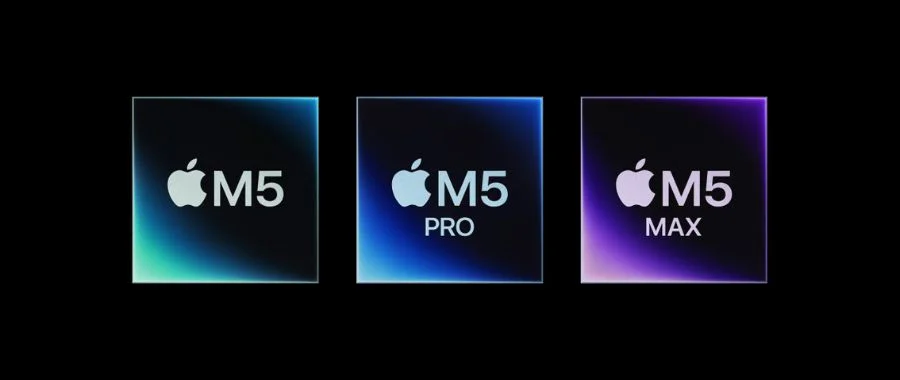

Apple released a whole suite of new Mac products last week, from classic MacBook Pros to the all-new MacBook Neo. But with the newest MacBooks come some upgraded-if confusing-technology. We're here to help sort through what helps these new MacBooks work as powerfully as they do: the M5 chip, the M5 Pro chip, the M5 Max chip, and the A18 Pro chip.
What Are Apple M5 Chips?
If this is all new to you, you're not alone. Apple first introduced its series of M chips back in 2020 with the M1, the first Apple Silicon chip. Instead of using Intel chips, Apple has since been creating its own custom ARM-based SoCs, or system-on-a-chip processors. The goal? Better performance, and each model integrates the device's CPU, GPU, unified memory (or RAM), Neural Engine and more. Much of the power that you'll want from an Apple device lives on this one system, with the latest being the M5 chip, the M5 Max chip, the M5 Pro chip, and the A18 Pro chip. Below, we dive deeper into some of these terms. But what is the difference between the latest Apple chips?
- CPU: The central processing unit, this collection of mighty cores works through tasks. High-performance cores are dedicated to jobs that demand more, while high-efficiency cores work on low-power assignments instead.
- GPU: The graphics processing unit works to quickly process and render images on your device's screen.
- Unified Memory (RAM): Unified memory is a type of RAM that works with the CPU to process tasks quickly, like when you're opening an application. With Apple Silicon, RAM is beside the CPU and GPU for quick access and powerful, swift performance.
Meet the M5 Chip Family

Technically, this isn't the first we've seen of the base M5 chip. It was originally launched and announced back in October of 2025, appearing in the 14-inch MacBook Pro, the AI Vision Pro and iPad Pro at the time of launch. This multithreaded Apple chipset delivers some of the fastest and most powerful performance that Apple has ever been able to deliver, even when compared to other Apple Silicon chips. Part of that boosted power comes from an amazing Neural Engine, but the M5 Pro and M5 Max go even further beyond. Check out our chart below for some at-a-glance numbers that compare the M5 with the latest releases, the M5 Pro and the M5 Max. Then, we'll dive even further into what sets the M5 Pro and the M5 Max apart.
| Performance Elements | M5 | M5 Pro | M5 Max |
|---|---|---|---|
| Graphics Performance | 6x Faster Than M1 | 7.8x Faster Than M1 Pro | 8x Faster M1 Max |
| AI Performance | 16 Core Neural Engine | 16 Core Neural Engine & Neural Accelerator | 16 Core Neural Engine & Neural Accelerator |
| SSD Storage Unified Memory | Up to 32 GB | Up to 64 GB | Up to 128 GB |
| CPU | 10 Core | Up to 18 Core | 18 Cores |
| GPU | 10 Core | Up to 20 Core | Up to 40 Core |
All-New SoC Fusion Architecture
Apple blew people away with the first M1 System on a Chip, and the M5 Pro and M5 Max reinvent the brand's classic Apple Silicon Architecture. Two single dies are combined to create a single SoC, a space for a mighty CPU (outfitted with speedy super cores), a GPU that can scale, unique Media Engine, unified memory controller, Neural Engine, and Thunderbolt 5 capabilities. It's a lot to take in; what's a die, why are there two, and what sets this Neural Engine apart if it has the same number of cores as the original M5? First, the "die" is the piece of silicon that everything is built into. With double the die, you've got twice the space to work with to create your SoC.

Next, there's the CPU, complete with an 18-core CPU build that includes six high-performance cores&mdsah;called super cored- and 12 new performance cores crafted for multithreaded functionality and energy-efficiency. The result? A CPU that can handle up to 30% heavier workloads.
The GPU is just as impressive-or more. This graphics engine pushes the boundaries of what you'd expect with the ability to work with up to 40 GPUs. Plus, each GPU core has its own Neural Accelerator along with higher unified memory bandwidth. Combined, these functions all work together for an incredible increase in GPU compute for AI compared to previous chips you've seen-even from other chips' Neural Engines. Finally, there's what the baseline GPU is designed to do: create incredible graphics. Ray Tracing, 3D rendering and other boosted visual effects are all here. With these upgraded graphics capabilities, it's hard to think of another chip that can best the M5 Pro and M5 Max. A computer with one of these mighty engines inside is the perfect companion for heavy workflows, animators, developers and researchers.
Then there's the Neural Engine. If you've looked at the chart above, you might be asking, "What gives? All three chips have the same number of cores in the Neural Engine." That's true, but the GPU cores are designed with Neural Accelerators in each core. The speedier Neural Engine can connect to memory faster and works to accelerate on-device AI features, like Apple Intelligence. When you think of AI, you're probably thinking of a service that involves a connection to the cloud. Instead, the M5 Pro and M5 Max are working to beef up the power for on-device AI. From here, you'll get quick responses and find privacy you know you can believe in-along with the ability to work with your computer even when the internet is out.
Before we go further, know this: it's all about scale. The new Fusion Architecture is here to bring more speed and power to every task you complete, especially when it comes to graphics and AI tasks. We'll dive into that as we break down the differences between the M5 Pro and the M5 Max.
M5 Pro: A Heavy-Hitting Chip

While Apple Silicon chips have radically changed the game from their first launch, the M5 Pro steps things up even further. Aside from the new Fusion Architecture, Apple notes that this chip is crafted "to push the limits". That's thanks to the boost in multithreaded performance when compared to the classic M5. This chip can bring you 30% speedier performance even when you're pushing through heavy workloads and tough tasks. With incredible unified memory, even those who need to edit 8K video on the fly will have no trouble going to work wherever they are. This is a great chip for anyone who needs to work with AI both locally and in the cloud. Plus, its GPU can render 3D art and animation in moments. Extra storage gives you all the room you need to work on large files, too, whether you're editing massive video files or speeding through AI tasks on your computer.
M5 Max: The Strongest Apple Silicon Yet
Those in search of the best of the best have found it with the M5 Max chip. This chip is crafted for pro-tier folks who need all the power they can get, like computer developers, animators who work in 2D and 3D scopes and more-anyone who needs the most out of their GPU compute and a boosted unified memory bandwidth, it's here in the M5 Max chip. It's not unlike the M5 Pro, but you're getting a lot more power with this version-especially in terms of GPU. The new Fusion Architecture brings power and efficiency, while more GPU cores and new CPU architecture bring a boost in multithreaded performance and speed. There's more of everything, from unified memory to extra unified memory bandwidth. With that increase in bandwidth, you get more out of working with LLMs, along with other heavy tasks like extra-large sets of data and editing video scenes and difficult 3D imagery. Other impressive stats? The M5 Max chip brings users over 4 times the level of GPU compute you'd find in the M4 generation. The graphics performance is truly stunning and hard to compare: 20% higher than performance from the M4 Max, and the increase in Ray Tracing performance makes this a great choice for anyone who needs this functionality for apps and gaming.
The Macbook Neo: Meet The New A18 Pro Chip
The new M5 Pro Chip and M5 Max Chip weren't the only chips introduced last week. The entry-level MacBook Neo was just announced as well: a budget-friendly MacBook that's made more for working through tasks, web browsing, tackling homework, watching shows or even acting as a work computer. Unlike the other MacBooks currently available, this pick is designed more for play and productivity than heavy-lifting, and features the A18 Pro chip. The MacBook Neo is built in beautiful colors with all of the best features you'd love from a MacBook, but it doesn't have all of the power you'd expect from a new Pro or even an Air-this is an entry-level computer, and while it is multi-talented, it's made more for students and those hoping for a computer that can help them with productivity.

Now, the A18 chip. What's a bit wild is that it's an iPhone chip—the same one that runs the iPhone 16 Pro, in fact. That means that if you have an iPhone 17 Pro, your phone is actually stronger than this MacBook. Now, we just talked about the super-powerful M5 Pro and M5 Max chips, so we're dropping down a few levels to discuss an iPhone chip running a laptop. But consider this: the A18 Pro is still Apple Silicon, which is one of the most important things to keep in mind. It has fewer cores than an M5 chip, though, which is to be expected based on the vast price difference. The A18 Pro chip has six CPU cores, with two devoted to performance and the other four labeled "efficiency cores". The MacBook Neo uses a 5-core GPU as well, a binned version of the classic 6-core model on the iPhone 16 Pro.
While the A18 Pro doesn't sound the most impressive, we'll remind you again that it's Apple Silicon, and its performance actually falls in between that of an M1 and an M4 chip. It's less speedy than any other M5 chips, but it can still accomplish a lot of what you'd be looking for on a classic laptop. This chip (especially on the MacBook Neo) is a great option for students, productivity and workers looking to chew away at classic tasks like spreadsheets, email, writing, and more. As a matter of fact, you can do a lot with your iPhone. It's not too far-fetched to think that it could run a laptop.
Which Mac Chip is Right for Me?
So, which M5 chip (or A18 Pro chip) is right for you? We're looking at a good/better/best situation, but dialed up to high-performance levels. We just mentioned that the A18 Pro chip is a good pick for entry-level users, students and even workers who need help with productivity. Next, quality flies up with the M5 chip, where storage, AI capacity, graphics performance and more set the Apple Silicon chip apart.
Then, the Pro and the Max. How do you know whether the M5 Pro or M5 Max is right for you? Both are made with Apple's new Fusion Architecture, but they're still SoC and Apple Silicon. In truth, both are great chips that power incredible computers. But the M5 Pro is crafted to help users juggle demanding software and brings impressive processing power to the forefront, while the M5 Max carries the best possible performance you can find. The M5 Max chip is for folks who need the best they can get from graphics modeling and processing power. Think sound designers, data researchers, STEM professionals and other users who need the most out of their computers. Whether you need a top-tier creative outlet or are searching for a computer that can run as fast and far as you can, the M5 Max chip is right for you.
Find Apple at Abt
Searching for the latest MacBooks and the newest laptops? They'll be here at Abt in our Apple store ASAP. Head into the store to see the colorful Neo laptops in person, test out the MacBook Pros, and see everything else in the world of Apple. For speedy delivery, order online, and if you have more questions, reach out to our team of experts at 800-860-3577.
New MacBook Chips FAQs
-
The M5 Pro chip will be released in some of the latest MacBook Pro laptops, hitting the market on March 11, 2026.
-
Many would consider the M4 Pro a slightly better choice for high-performance tasks and heavy workloads, even when compared to the newer base M5. If you're looking for specific capabilities, break down specs and compare: do you need better graphics, or are more enhanced AI capabilities something you'd value more? Compare and contrast features to find the best chip (and MacBook) for you.
-
Apple MacBook Pros with the M5 Max chip will be released on March 11, 2026.
-
In the MacBook Neo, the A18 Pro chip has a 6-core CPU, a binned 5-core GPU, and a 16-core Neural Engine. The same chip for the Apple iPhone 16 Pro has a 6-core GPU.
-
Yes, the A18 Pro chip is mighty enough to run a complete MacBook, the MacBook Neo. Between the mighty CPU, its impressive Neural Engine and the newest binned GPU, it's impressive and efficient. This iPhone-level chip can run an entire computer without breaking a sweat.


